Clique aqui para ler em Português

As I’ve already mentioned here, the Agile Brazil 2010 conference is accepting session proposals to be part of our program. Already with more than 90 sessions proposed, the program committee decided to postpone the deadline for session submissions until next Sunday (7th March 2010) due to requests and to allow more time for the community to interact and help us build the program. Some new functionality was also released:

  • Users are now able to add comments to the sessions. We want the community to provide feedback to help our authors to improve their sessions prior to the deadline;
  • You can now vote and help us choose the conference logo. We received many proposals, and narrowed it down to 3, and we’re now asking the community to vote on the winner.

In order to participate voting or adding comments, you don’t have to fill out the full author profile, so visit our website (if you haven’t created your account yet) and participate!


[Agile Brazil 2010] Prazo de envio de sessões prorrogado e concurso do logo

Como já publiquei aqui, a Agile Brazil 2010 está aceitando propostas de sessões para fazer parte do nosso programa. Com mais de 90 sessões propostas, o comitê de programa decidiu prorrogar o prazo de submissões até o próximo domingo (7 de Março de 2010) devido a pedidos e para dar mais tempo para a comunidade interagir e nos ajudar a montar o programa da conferência. Algumas novas funcionalidades foram lançadas:

  • Usuários agora podem adicionar comentários nas propostas existentes. Queremos que a comunidade nos ajude fornecendo feedback aos autores e ajudando-os a melhorar suas propostas antes do prazo final;
  • Você pode agora votar e nos ajudar a escolher o logotipo da conferência. Nós recebemos diversas propostas de logotipo e escolhemos 3 para a votação final, onde a comunidade vai decidir o vencedor.

Para participar da votação ou adicionar comentários, você não precisa preencher o perfil completo de autor, então visite nosso website (se ainda não criou uma conta) e participe!

Post to Twitter

Clique aqui para ler em Português

I’m one of the organizers of the program committee for Agile Brazil 2010, and we’re very happy to announce that ThoughtWorks has agreed to sponsor the visit of Martin Fowler, our Chief Scientist, as one of our keynote speakers. Since this is Martin’s first visit to Brazil, I decided to ask him some questions that I thought would be of interest to the participants, and he has kindly agreed to participate in this mini-interview:

Q: What have been keeping you busy lately?

Martin Fowler: Overwhelmingly it’s my upcoming book on DSLs. I found writing books to be hard work, and it’s actually getting harder. By June I expect all of the content will be cast so my mind will be able to get away from it – which I’m very much looking forward to.

Q: What are your expectations about Agile Brazil 2010?

MF: I try not to have expectations about things, that way my mind can be open to the reality when I see it. I’ve been doing conferences frequently for two decades now, so it’s hard to get excited about them. I am excited about coming to Brazil. It will be my first time in South America and both I and my wife have long wanted to come down.

Q: What are you going to talk about in your keynote?

MF: I have no idea. I often don’t decide on my keynote until very close to speaking – often doing extemporaneous talks <http://martinfowler.com/bliki/ExtemporarySpeaking.html>. Recently I’ve been doing keynote talks consisting of three or so talklets, some with slides, some without. But exactly how I’ll do it is something I may only decide the night before.

Q: How do you see the Brazilian software community influencing the future of Agile?

MF: It’s hard to say, as I’m not that familiar with the Brazilian software world. I’ve been very impressed by the Brazilian ThoughtWorkers I’ve met over the years, so I know there’s great potential here. I’m generally keen to see more varied cultures contribute to the software world, I think it’s an important part of us growing as a profession.

Agile Brazil 2010 is going to be an incredible conference, and we’re inviting speakers to submit session proposals (the deadline is approaching: 28/Feb!). Don’t miss the chance to see and talk to Martin Fowler, as he’s one of the few speakers I know of that can put together a first-class keynote on the night before :-)

Don’t forget to follow @agilebrazil on Twitter for conference news, and hope to see you there!


[Agile Brazil 2010] Martin Fowler pela primeira vez no Brasil!

Como um dos organizadores do comitê de programa da Agile Brazil 2010, estamos felizes em anunciar que a ThoughtWorks aceitou patrocinar a visita de Martin Fowler, nosso Cientista-Chefe, como um dos keynotes do evento. Como esta será a primeira vez que Martin visita o Brasil, decidi fazer algumas perguntas que julguei interessantes para os participantes do evento, e ele concordou gentilmente em participar desta mini-entrevista:

P: O que tem te mantido ocupado ultimamente?

Martin Fowler: Surpreendentemente é o meu novo livro sobre DSLs. Eu acho que escrever livros é um trabalho árduo e na verdade isso tem se tornado cada vez mais difícil. Até Junho eu espero que todo o conteúdo esteja definido assim isso vai poder sair um pouco da minha cabeça – algo que estou realmente ansioso para acontecer.

P: Quais são suas expectativas para a Agile Brazil 2010?

MF: Eu tento não criar expectativas sobre essas coisas, assim minha mente pode estar aberta para a realidade quando eu a ver. Eu tenho participado de conferências frequentemente há duas décadas, então acho difícil me empolgar com elas. Mas estou empolgado em visitar o Brasil. Esta será minha primeira vez na América do Sul e tanto eu quanto minha esposa estamos ansiosos há tempos por essa visita.

P: O que você irá abordar no seu keynote?

MF: Eu não tenho idéia. Eu geralmente não decido o assunto do meu keynote até uma data muito próxima do evento – geralmente fazendo palestras extemporâneas (improvisadas) <http://martinfowler.com/bliki/ExtemporarySpeaking.html>. Recentemente eu tenho feito keynotes com em torno de três pequenas palestras, algumas com slides, outras não. Porém decidir exatamente como irei fazê-lo vai ser algo que eu possivelmente decida na noite anterior.

P: Como você vê a comunidade brasileira de software influenciando o futuro dos Métodos Ágeis?

MF: É difícil dizer, pois não estou tão familiarizado com o mundo de software brasileiro. Eu tenho me impressionado bastante com os ThoughtWorkers brasileiros que conheci ao longo dos anos, então eu sei que existe um grande potencial aqui. Em geral eu gosto de ver uma variedade maior de culturas contribuindo para o mundo do software, pois acredito que seja uma parte importante para crescermos como profissão.

A Agile Brazil 2010 vai ser uma conferência incrível, e estamos convidando palestrantes para submeterem propostas de sessão (a data limite está se aproximando: 28/Fev!). Não perca a oportunidade de ver e conhecer o Martin Fowler pessoalmente, pois ele é um dos poucos palestrantes que conheço que consegue preparar um keynote da mais alta qualidade na noite anterior :-)

Não esqueça de seguir @agilebrazil no Twitter para notícias da conferência, e espero ver vocês por lá!

Post to Twitter

I’m helping to organise the first nation-wide Agile conference in Brazil, that will take place in Porto Alegre next 22-25th June. Agile Brazil 2010 is a joint effort to bring together all the Agile communities around Brazil (industry and academy), and the conference goal is to promote communication and collaboration among its attendees aiming to disseminate the Agile culture in the whole country. Some of the confirmed international guest speakers are ThoughtWorks’ Chief Scientist Martin Fowler, Philippe Kruchten, and David Hussman.

After working the past month on building the submission system, I’m happy to announce that we’re inviting you to join as a speaker of this great event too! Tell Brazil about your experiences, present your research and share your products and learnings! You can find the deadlines and the submission guidelines at:

http://submissoes.agilebrazil.com

To find out more about the conference, please visit our website, or follow @agilebrazil on Twitter.

Post to Twitter

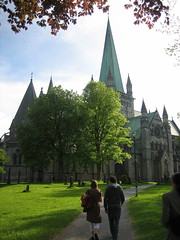
Agile has shown that doing prolonged analysis upfront bears little to no value to the customer. However, doing none means the project lacks the direction that it needs. The question is, how much analysis is enough before the project starts? This will be the theme of my recently accepted “Inception Workshop: Kickstarting an Agile project” that will be pair-presented with Jenny at XP2010, in Trondheim, Norway.

My journey to find the right balance between a generalist/specialist in software has led me to projects where I had to play not only the developer role, but several to varying degrees (PM, BA, QA, Architect, Coach, team lead, …) This is my attempt to share my knowledge towards those different areas, by pairing with an experienced BA and talking about Agile project initiation.

In this workshop, we will share our experience of participating in several project inceptions. Participants will work in a condensed project inception, solving a business problem and using some tools to shape the project for delivery. Our goal is also to learn from other practitioners about the tools and techniques they’re using successfully in their projects.

More details about the session can be found at the XP2010 session description:

http://xp2010.agilealliance.org/node/5380

We are very excited about this session, and we hope to see you in Norway to participate and share your experiences too!

Post to Twitter

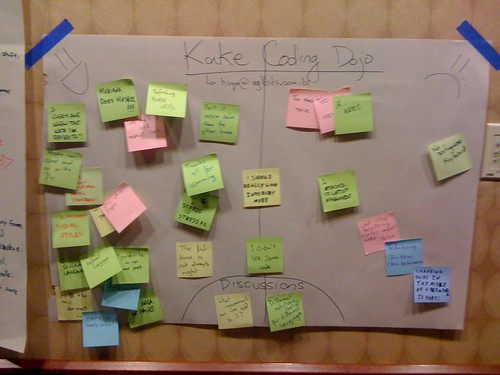
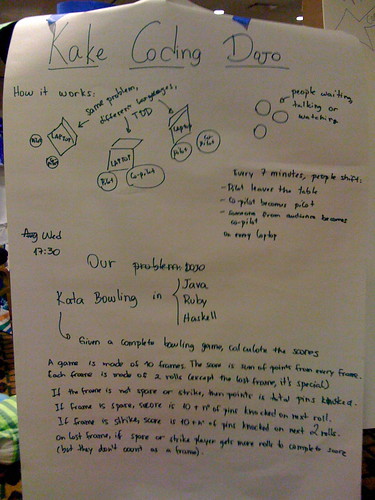
I’m here having a great time in Chicago, at Agile 2009. I will write more about the sessions in later posts, but I wanted to talk about the Coding Dojo we ran at the Open Jam. Organised by my friends from the Dojo@SP (thanks Hugo, Mari, and Thiago!), we tried a projector-less format that went really well. I wrote about the Kake Format a while ago, although the name changed.

It was a lot of fun, and we were lucky to bump into Emmanuel Gaillot around in Chicago, who made it to the session as well. We solved the Kata Bowling in three different stations: one in Ruby, one in Haskell, and one in Java. The code is available on GitHub, and these are some pictures I took during the session:

Coding Dojo @ Agile 2009

Retrospective after the Dojo

If you want to try out a dynamic format, where people have more chance to participate and train different skills, and you don’t have a projector available, I urge you to try out the Kake Format on your Dojo and share your experiences!

New format and rules

Post to Twitter

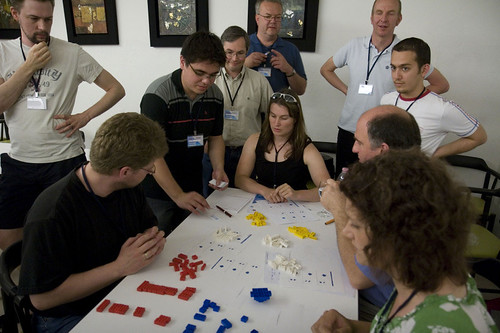
Last week marked the 10th edition of the XP 200x conference, held in Sardinia, Italy. Me and Francisco were there to present an extended version of our Lego Lean Game. Being selected as the first session on the first day of the program, we were expecting a small audience, but it turned out to be quite well attended by about 20-25 people.

Lean Lego Game

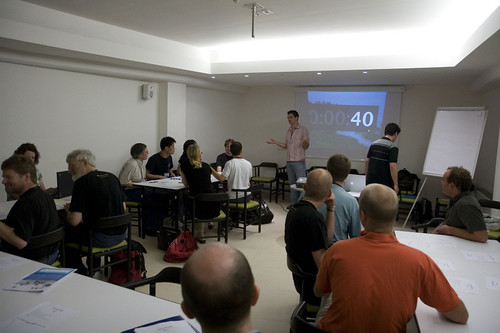
We started the session a bit delayed, due to the lack of room organisation: I was a bit shocked when we arrived and the room was arranged as a normal “lecture room”, rather than the usual group tables (that we requested a week before). Projector and flipchart were not available, so it took us about 15 minutes to have everything ready to begin.

The slow start, however, did not got in the way of the overall workshop. We have designed the activities in a flexible way that allow us to adapt their length just-in-time so we still managed to cover everything we wanted without having to rush.

The first half of the workshop was mostly the same version we presented last year in Buenos Aires, with slight modifications based on feedback we got from participants. The second half, however, was mostly new and we included an activity to allow each team to come up with their own processes (rather than following ours). This turned out to be a great success! Each group came up with different ideas and, by watching the other teams perform, we had an interesting discussion about the different approaches and results. We now think that the original version is too condensed :-)

Lean Lego Game

The feedback we received after the session was great and a lot of people asked us for the material to run the session themselves. Me and Francisco have a “game package” that we can share for those interested in running the game. Get in touch with us if you’re interested! You can find more photos of our presentation here, here, and here (thanks to Hubert for sharing his pictures!). The slides are also available:

We are very interested in your feedback. So, if you were at the conference or want to use the material to run the workshop, please let us know! Share your experiences and help us make it better!

Post to Twitter

XP 2009 is happening between 25-29th of May in Sardinia, Italy and I will be there attending and presenting some interesting workshops:

  • The Lean Lego Game: Me and Francisco have been improving our workshop since we last presented it at Agiles 2008 in Argentina, and we will be presenting a long version (180 minutes) on Monday, May 25th. We have just a few “seats” available to participate on the session (20-24) and it will be occupied in a first-come-first-serve basis. If more people show up we have plans to try and not reject anyone, though.
  • Test Driven Development: Performing Art: Emily Bache kindly invited me to present a Prepared Kata at her workshop and I will be pairing with Francisco for 30-40 minutes, programming in Ruby with RSpec/Cucumber. Should be fun to “perform” and watch the other pairs as well. Looking forward to that session on Wednesday afternoon!

My fellow ThoughtWorker Pat Kua will be there presenting a workshop as well. I will try to brush up my (lately lazy) writting skills and publish some conference reports. And hope to see you all there in Sardinia!

Post to Twitter

The last conference I attended in October was Falando em Agile (Talking about Agile), a 2-day conference organized by Caelum. First of all I need to thank all the organizers for inviting me to speak and for putting together such a great conference.

Conference Badges

The content was very mixed, with some people focusing on the management aspects of Agile, while others highlighting the importance of the technical side (with some in between, as well as interesting experience reports). About 200 participants showed up with great questions and experiences, which impressed me and showed how much Agile has grown in Brazil since last year.

David Anderson gave the opening keynote, which focused on his “Recipe for Success”. I find he’s a very opinionated speaker and he can get me both agreeing and disagreeing with him at the same time, which is interesting because we can always learn something. At the same time that I don’t believe in a recipe for success, I strongly agree with his points about how the focus on quality leads to fast delivery, focusing on the engineering aspects to build quality in.

The second talk was mine and Frankie’s about Agile adoption anti-patterns that we noticed in our experiences applying Agile in the “real world”. I think the presentation went really well and the feedback we got was very positive. A lot of people came to talk to us during the break to tell us they’ve identified themselves in a lot of our examples, and that they liked to see us talking about what didn’t work instead of the bright/good things we like about Agile. The slides are available here (in Portuguese).

After lunch, Adail gave a talk about Agile thinking, showing tools such as mind maps and theory of constraints trees. After that, the guys from SEA Technology presented a very interested case study of their attempts of applying Agile in a government project in Brasília. Very interesting to hear their experiences and how it’s possible to apply Agile even in the most adverse environments.

José Papo gave a talk about different types of contract and how their are suitable (or most commonly not suitable) for Agile. The closing talk of the day was given by my friend Guilherme Chapiewski about Agile Leadership. It was interesting to see that he gathered a lot of topics on the subject from different sources and his own experience, arguing about the conflicts of being a leader that provides technical versus process guidelines. I’ve been recently reading a lot about Lean, and my current thinking goes much towards a Chief Engineer role, with a strong technical background, but at the same point with a holistic view of the product and what is value from the customer’s perspective. I missed this topic from his talk, but it was overall really good.

The second day started with traffic again, so I missed Alexandre Magno’s talk about Scrum in PMI environments. Danilo Bardusco gave a great experience report of how they are adopting Scrum at Globo.com, the largest media company in Brazil. I think this kind of experience report is really important for people who are starting with Agile, because it shows how hard it is to change a company’s culture and some of the problems they might find on the way. The last talk before lunch was given by Prof. Fabio Kon and Daniel Cukier: they are both members of AgilCoop (which I’m also part of) and gave a great summary of Linda Rising’s and Mary Lynn’s book “Fearless Change”, showing patterns for introducing new ideas.

Because of the short lunch break (only 1 hour), I was late to watch Daniel Wildt’s talk about his experiences as an Agile coach at Dell. Antonio Carlos from Yahoo!, gave an interesting talk about the importance and the responsibilities of a Product Owner (which I would generalize as the customer in general). The closing keynote was from my co-worker Philip Calçado, where he shared his experience in 2 different projects where bad management decisions made an Agile adoption less successful. I particularly liked his point that “Agile is about inspecting and adapting, but you need to understand what you are doing”. Dropping practices or putting others in place without understanding why they are important may be more harmful to the team.

Overall the conference was really good and I enjoyed seeing my friends and meeting new people enthusiastic about Agile. I was really impressed with how Agile has grown in Brazil since last year. Next year’s conference is promising to be even better and I’m looking forward to participate again.

Post to Twitter

Continuing the series of conference reports, me and Frankie spend a day in Buenos Aires, Argentina to present a Lego(tm) Game we developed to teach some Lean practices and principles at Agiles 2008. The conference was held during the full week of 20-25 October, including three concurrent 2-day Certified Scrum Master trainings and Mary and Tom’s 2 day course on Lean Software Development.

Agiles 2008 - Buenos Aires

Unfortunately, we were not able to stay for the whole week, but spending one day gave us a pretty good impression of how Agile is growing in Latin America. The conference had about 400 participants during these 5 days and they had to reject some of the 900 interested due to logistics constraints. As happened in the US and Europe, the major driver for Agile adoption is being Scrum and, as more people start adopting it, the more problems are uncovered about how they can improve on the “technical” engineering practices.

Agiles 2008 - Buenos Aires

Mary’s opening keynote was exactly about that: how important it is to look at the engineering side of Agile to make its success sustainable. This was the same talk she gave at Agile 2008, highlighting the successes and failures (Plank Roads) of our short software engineering history. I thought it was much better than the last time I saw it, and she managed to convey her message in a much more clear way: focusing on processes/life-cycle has been fragile, while strong technical and engineering practices has shown success throughout our history.

Me presenting

Our workshop went really well: the number of participants and their level of knowledge on Lean matched exactly what we had in mind when we developed it. I’m not going to describe the dynamics of the session, because Frankie already did a good job in doing that. Suffice it to say that the feedback we received was great and that we already have some changes to make it even better. I’m also making the slides available here, although you would have to participate on the hands-on exercises to fully understand it.

Lego Houses

I think the overall message of our session was to show how some of the Lean practices work in practice, but also highlight the importance of Systems Thinking and the principles behind the practices. Blindly applying a practice may give you marginal results, but to fully embrace a Lean philosophy you need to keep learning and improving. There’s not an easy recipe to success.

After a good lunch (with Argentinian steak and some Brazilian friends), we went back to the venue and didn’t have a lot of time to watch any other session, so we rushed to the airport. Next year’s conference is promissing to be even bigger, and besides wanting to stay for the whole week, I hope to see more Brazilians sharing their Agile experiences with the Latin American community.

Post to Twitter

I’ve finally settled down in London and took some time to start the conference reports from the last couple of weeks. The first one I attended in São Paulo was Rails Summit Latin America. It was very well attended (500+ participants) and organized. I should give a special thanks to Fabio Akita and Locaweb for putting such a great conference together!

The conference started a bit earlier to me, when we went out with the other “foreigner speakers” (that’s how non-Brazilians are called in the airport…) to eat Feijoada and drink Caipirinha! Lots of fun! It was really cool to hang out with George, Jay, Obie, Desi, Dr. Nic, Chris, David Chelimsky, Luis Lavena, Akita, and Tim.

The first day of the conference started with DHH’s remote Q&A session, which was OK but nothing new or exciting. The following talk was really good: Chad Fowler gave an inspiring keynote about “Being Remarkable” which was a good summary of his book, plus his skills as a presenter and a good deck of slides (and videos). Very good!

Me and George skiped lunch to rehearse and give some final touches on our presentation about REST. I thought the presentation flowed very well, and it ended up being the only technical session on the main stage during the first day, even though we didn’t show any code: our goal was to talk about REST as an architectural style, basically summing up the great work of Fielding and the good practices that people on the REST community have been talking about. We also wanted to talk about other alternatives to building services on the internet. The slides are available here (we added some notes to make it easier to follow our train of thought).

Dr. Nic gave a funny and entertaining presentation about contributing to Open Source projects and the “Path to Awesomeness”. The first day finished with Chris’ keynote, which was very similar to the one he presented at Ruby Hoedown. If you’re interested, watch it on Confreaks. After his talk, Fabio moderated the Birds of a Feather session (which was more like Lightning Talks), and I was very surprised to see a lot of people stepping up to talk in their 5 minutes slot. The topics ranged from politics to organizing a study group, with special kudos to the Phusion guys who showed a Brainf*ck interpreter in Ruby. Of course, the day couldn’t finish without a rodízio of Brazilian steak at the churrascaria.

On the second day, I experienced the great joy of São Paulo traffic and didn’t made it to watch the Phusion guys’ presentation. I’ve heard from a lot of people it was great and that they gave a great talk about scalability (as well as a lesson on how to use Keynote properly). I arrived during Charles Nutter and Thomas Enebo’s talk about JRuby. It was held remotely and I know Akita had a lot of work to get the environment working. In the end, we still experienced some latency issues but the demos worked out quite OK. After that, Jay gave an interesting talk about the “Immaturity of Testing”, which was rooted in a last-minute presentation we put together for the UK ThoughtWorks Away Day back in June with George. It was great to see how much the discussions from our internal session enhanced the overall message and how Jay managed to put it all together in a nice format. I think a lot of people learned from the pros and cons that he discussed.

After lunch, the ‘testing’ theme continued with David Chelimsky presenting a double talk on RSpec and Cucumber, the gem that’s being developed by Aslak right now and will eventually replace RSpec’s current Story Runner. I wasn’t present during the second half, because I was preparing to present next about my lessons learned about testing. The slides (in Portuguese) are also available and I received some good feedback about it from the brazilians who prefered to watch me instead of David :-)

I stayed around the Brazilian track to watch my friend Fabio Kung present on JRuby and give a real-life demo of his experiments with JMagLev. After that, we all went to watch the closing keynote, by Obie Fernandez. It was a great talk about the Hashrocket way, which was heavily based on their way of applying Agile. In the end, he managed to get standing ovation from some folks in the audience. The last day finished with a lot of champagne and free beer, closing two days of networking, fun, Ruby, and Rails.

My overall impressions from the conference were very positive. It was great to see how much the Brazilian Rails community has grown over the past year. When Fabio and I organized the first RejectConf, back in 2007, we managed to get 100 people to show up in a Saturday and that triggered a lot of other small local conferences throughout Brazil. Seing everyone together for the first time, was a great chance to do the usual networking, and to share our experiences working with Ruby and Rails. I suspect next year’s conference will be even better. See you there!

Post to Twitter


© 2007-2009 Danilo Sato | iKon Wordpress Theme by Windows Vista Administration | Powered by Wordpress